
tinggalkan mesej
Jika anda berminat dengan produk kami dan ingin mengetahui lebih lanjut, sila tinggalkan mesej di sini, kami akan membalas anda secepat mungkin.




Pembelian terbaik yang saya buat musim sejuk ini! Warna dan hasil rajutannya sangat cantik dan sangat selesa! Pergi dari NYC ke Miami tanpa pernah menanggalkannya. Sangat comel!!
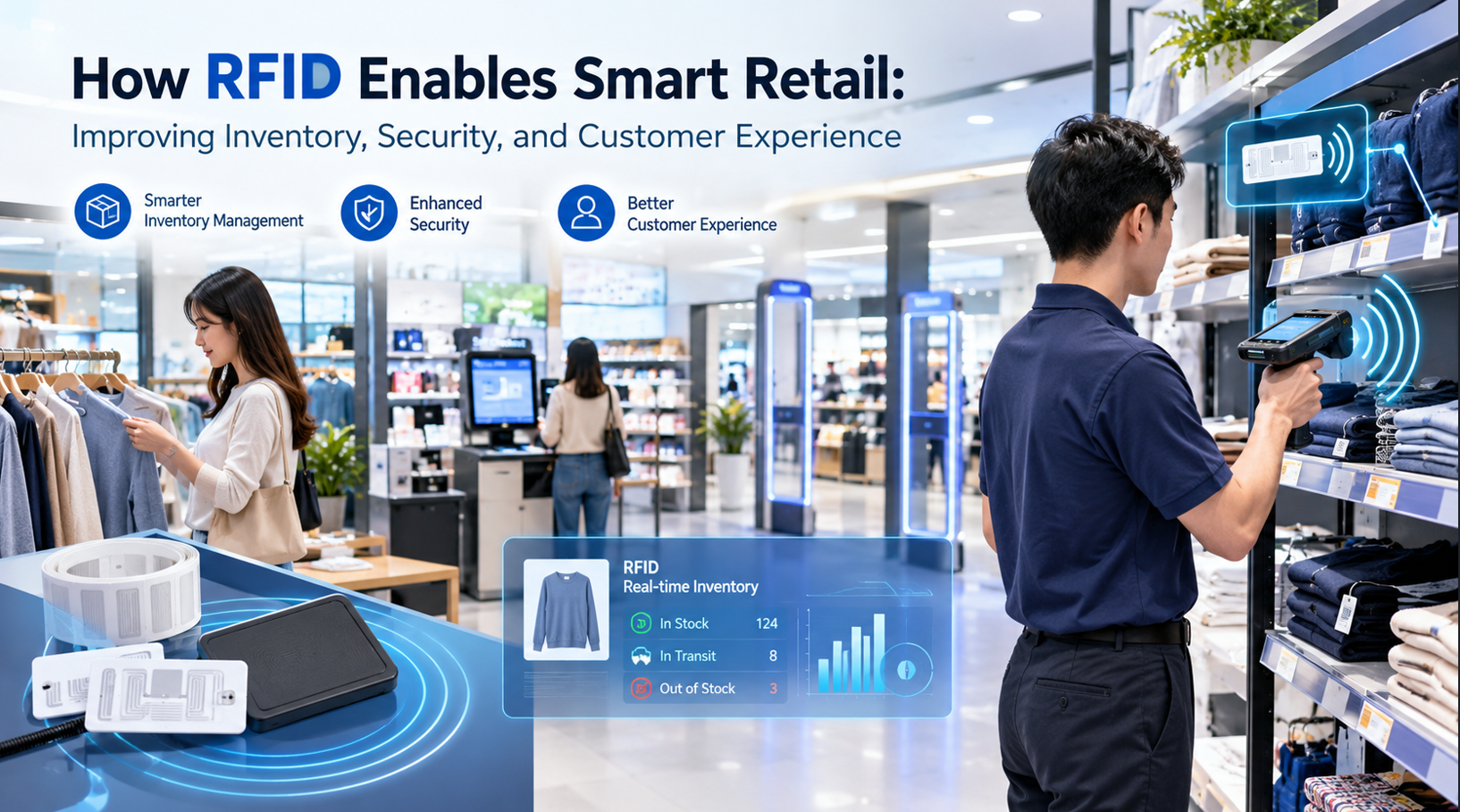
The retail industry is undergoing a significant transformation as businesses adopt digital technologies to improve operational efficiency, enhance customer experiences, and respond to changing market demands. Traditional retail management methods, which rely heavily on manual inventory counting, barcode scanning, and periodic stock checks, are becoming increasingly insufficient for retailers managing large product catalogs, multiple stores, and complex supply chains. Radio Frequency Identification (RFID) technology offers a practical solution by enabling automatic product identification, real-time inventory visibility, and more intelligent store operations.
RFID uses radio waves to identify and track items equipped with RFID tags. Unlike traditional barcodes, which generally require direct line-of-sight scanning, RFID systems can read multiple tagged items simultaneously without needing to scan each label individually. This capability makes RFID particularly valuable in modern retail environments, where speed, accuracy, and data visibility directly influence profitability.
From inventory management and loss prevention to self-checkout and omnichannel retailing, RFID is helping retailers build smarter, more connected business operations.
Accurate inventory information is essential for successful retail operations. When a store's inventory records do not match its actual stock, retailers may experience stockouts, overstocking, missed sales opportunities, and unnecessary replenishment costs.
Traditional inventory counting often requires employees to scan products individually or count them manually. These processes consume time and can introduce human errors, particularly in stores with thousands of stock-keeping units (SKUs).
RFID simplifies inventory management by allowing retailers to identify multiple tagged products in a single reading operation. Fixed RFID readers installed at specific locations or handheld RFID readers used by employees can collect product information quickly and update inventory records automatically.
For example, a clothing retailer can use a handheld UHF RFID reader to scan shirts, trousers, and jackets across shelves, racks, and storage rooms. Instead of checking every barcode individually, employees can identify many products within a short period and compare the collected data with the inventory management system.
RFID also helps retailers maintain more accurate records of product movement. When merchandise enters a stockroom, moves to the sales floor, or passes through a designated checkpoint, RFID readers can capture relevant identification data. With appropriate system integration, these events help retailers understand where products are located and whether recorded stock levels reflect actual conditions.
Better inventory visibility enables faster replenishment, more reliable stock information, and more informed purchasing decisions.
Stocktaking is a necessary but labor-intensive retail activity. In traditional environments, employees may need to close certain areas, remove products from shelves, or spend hours scanning individual barcodes to complete an inventory count.
RFID can significantly reduce this workload.
An RFID-enabled stocktaking system typically includes RFID tags attached to merchandise, handheld or fixed RFID readers, antennas, and inventory management software. The reader communicates with nearby tags and collects their unique identification numbers. The software then compares the collected information with the retailer's existing inventory records.
Because multiple tags can be read without individual line-of-sight scanning, employees can count products on shelves, clothing racks, or within storage areas more efficiently. The actual performance depends on tag placement, reader configuration, product materials, and the surrounding radio-frequency environment.
For retailers operating multiple branches, RFID can support more frequent inventory checks without requiring the same amount of labor as traditional methods. More frequent stocktaking helps identify discrepancies earlier, allowing staff to investigate missing products, misplaced merchandise, or incorrect inventory records before these issues affect customers.
Instead of treating stocktaking as an occasional, disruptive task, retailers can move toward continuous inventory verification.
Modern customers expect a consistent shopping experience across physical stores, websites, mobile applications, and online marketplaces. They may browse products online, purchase through an app, and collect their orders from a nearby store. However, these services depend on reliable inventory information across different sales channels.
RFID helps retailers improve omnichannel operations by providing more accurate visibility into merchandise held at individual stores and distribution locations.
When RFID data is integrated with order management and inventory systems, retailers can more confidently determine whether a product is available at a particular location. This information supports services such as buy online, pick up in store (BOPIS), ship from store, and store-to-store transfers.
Consider a customer looking for a particular jacket in a specific size. If the retailer's website indicates that the jacket is available at a nearby branch, employees can use RFID to verify its presence and locate it more efficiently. The store can then prepare the order for collection or arrange delivery.
RFID can also help employees find misplaced items in backrooms or on the wrong shelves. This improves the efficiency of order picking and reduces the likelihood of canceling orders because products cannot be located.
By connecting physical inventory with digital sales channels, RFID helps retailers create a more responsive and dependable shopping experience.
RFID does more than improve back-end operations. It can also support more convenient and personalized shopping experiences.
In apparel stores, RFID-enabled smart fitting rooms can identify tagged products brought into the fitting area. When connected to an appropriate customer interface, the system may display product information, available sizes, alternative colors, or matching items. Customers can request assistance without leaving the fitting room, while staff receive more precise information about the products they need to retrieve.
RFID can also support interactive product displays. For example, a customer examining a tagged product may access information about its specifications, available variations, or related accessories through a connected display or retail application. These functions require suitable software, user interfaces, and integration with product information systems; RFID alone does not provide personalized recommendations.
At checkout, RFID can enable systems to identify multiple tagged products simultaneously, reducing the need to scan each item individually. Depending on the system design, this can shorten checkout times and help reduce queues during busy shopping periods.
Retailers must still account for payment authorization, product verification, exception handling, and applicable privacy requirements. Nevertheless, RFID provides a foundation for faster, more convenient, and increasingly automated shopping experiences.
Retail shrinkage can result from shoplifting, internal theft, administrative errors, damaged goods, and other inventory discrepancies. Although RFID cannot eliminate all forms of shrinkage, it can improve merchandise visibility and help retailers identify unusual product movements.
RFID-enabled security gates installed at store exits can detect tagged merchandise passing through designated areas. When integrated with point-of-sale systems, these gates can help identify products that have not been recorded as sold or otherwise authorized for removal.
For example, if a tagged item passes through an exit without a corresponding sales record, the system may trigger an alarm or notify store personnel. The exact behavior depends on the security configuration and the integration between the RFID system and checkout software.
RFID also helps retailers investigate inventory discrepancies. By comparing product-level records with physical stock, managers can identify missing items, investigate unexplained movements, and determine which product categories or locations require closer attention.
In distribution centers and stockrooms, RFID checkpoints can record the movement of tagged goods between designated areas. These records improve traceability and help businesses establish clearer procedures for receiving, transferring, and dispatching merchandise.
RFID should be treated as one component of a broader loss-prevention strategy that may also include electronic article surveillance, access controls, transaction monitoring, and staff procedures.
Retail inventory management extends beyond the store. Products move through manufacturers, distribution centers, warehouses, transportation networks, and retail branches before reaching customers.
When product movement is recorded manually or through disconnected systems, retailers may struggle to determine where goods are located or why deliveries are delayed.
RFID can improve supply chain visibility by capturing product identification data at important checkpoints. Tags attached to individual products, cartons, reusable containers, or pallets allow businesses to record receiving, sorting, shipping, and delivery events.
At a distribution center, RFID readers can identify tagged cartons as they pass through designated receiving or dispatch areas. This can reduce manual scanning and help employees compare incoming or outgoing goods with shipment records.
When integrated with warehouse management systems (WMS), enterprise resource planning (ERP) platforms, and transportation management systems, RFID data can support more accurate shipment verification and faster exception detection.
Retailers can also use improved inventory data to support replenishment decisions. When stock levels fall below defined thresholds, the system can generate alerts or recommendations for replenishment. Managers can then allocate products according to actual demand, store performance, and availability across the network.
The result is a more connected supply chain in which product movement is easier to monitor and inventory decisions are based on more reliable information.
Smart retail depends on more than collecting data. Retailers must transform that data into actionable information that improves business performance.
RFID generates detailed records about product identification and movement. When these records are combined with sales data, inventory history, and other operational information, retailers can develop a clearer understanding of store performance.
For example, managers can compare the number of products delivered to a store with the number sold and the quantity remaining in stock. They can investigate discrepancies, identify slow-moving merchandise, and evaluate whether particular products are consistently unavailable when customers want to buy them.
RFID data may also support analysis of merchandise movement between storage areas and sales floors. This helps managers evaluate replenishment processes and determine whether employees are spending too much time searching for or moving products.
Over time, these insights can inform assortment planning, inventory allocation, and store-level operational improvements.
However, RFID data should not be interpreted in isolation. Read events may be affected by interference, missed reads, duplicate reads, or incorrect tag associations. Effective analytics therefore requires appropriate data filtering, validation, and integration with other business systems.
The effectiveness of a smart retail system depends on selecting hardware that matches the application, merchandise, and store environment.
UHF RFID technology is widely used in retail inventory management because it supports relatively long read ranges and can identify multiple tags quickly. The appropriate operating frequency depends on regional regulations and the system's intended market.
Different RFID devices serve different purposes. Handheld RFID readers are useful for stocktaking, locating products, and investigating inventory discrepancies. Fixed RFID readers and antennas can monitor designated areas, such as receiving points, stockroom entrances, and checkout zones. RFID gates can support merchandise movement monitoring and security applications.
RFID tags must also be selected carefully. Labels designed for clothing and general retail merchandise may not perform well when attached directly to metal products or liquid-filled containers. In these cases, specialized tags or alternative mounting positions may be necessary.
Before deployment, retailers should evaluate read range, tag orientation, reading speed, antenna coverage, interference, and the density of tagged products. Testing should take place in a realistic store environment rather than relying exclusively on laboratory specifications.
Equally important is software integration. RFID hardware must work with inventory databases, POS platforms, WMS or ERP systems, and other relevant applications. Without reliable data integration, faster tag reading will not automatically translate into better retail management.
Implementing RFID involves costs associated with tags, readers, antennas, software, system integration, employee training, and ongoing maintenance. Retailers should therefore evaluate the expected return on investment before committing to a large-scale deployment.
Potential benefits include reduced labor hours for stocktaking, improved inventory accuracy, fewer misplaced products, lower costs associated with inventory discrepancies, and more efficient order fulfillment.
A practical evaluation begins by establishing a baseline. Retailers can record how much time employees spend counting stock, how often inventory records are inaccurate, how many online orders cannot be fulfilled, and how frequently products are unavailable despite being listed in inventory.
After introducing RFID, these indicators can be measured again under comparable conditions. The difference helps determine whether the system is delivering measurable operational improvements.
For example, a retailer may begin with a pilot project in one store or product category. The pilot can test tag performance, reading accuracy, software integration, and employee workflows before the business expands the system to additional locations.
A phased implementation reduces deployment risk and helps retailers identify the applications that deliver the greatest value.
RFID is becoming an important enabling technology for smart retail because it connects physical merchandise with digital inventory and business systems. By improving inventory accuracy, accelerating stocktaking, supporting omnichannel fulfillment, enhancing merchandise security, and strengthening supply chain visibility, RFID helps retailers manage products more efficiently throughout their lifecycle.
Its greatest value comes from combining reliable RFID hardware with suitable tags, well-designed software, and clearly defined business processes. Retailers that begin with specific operational challenges, validate results through pilot projects, and expand according to measurable performance improvements can build a stronger foundation for digital transformation.
As retail continues to evolve, RFID will remain a practical tool for bridging the gap between physical stores and digital commerce, helping businesses make better decisions while delivering more convenient shopping experiences.

Maklumat terperinci dan PDF

Hubungan e-mel sokongan.

Bimbingan teknikal profesional.

Hubungan e-mel sokongan.



PAUTAN

Youtube

tinggalkan mesej
Imbas ke Wechat/Whatsapp :



 IPv6 RANGKAIAN DISOKONG